Research Ingestion
Feed research papers into Remind and have your agent curate them into a connected knowledge graph. Instead of reading each paper in isolation, the agent surfaces commonalities, contradictions, and themes across sources.
The problem
You read 10 papers on a topic. Each one has insights, but finding the threads that connect them — the agreements, the contradictions, the gaps — requires holding all of them in your head simultaneously. That's what your agent can do with Remind.
Setup
Create a project for the research topic:
mkdir ~/research/llm-memory
cd ~/research/llm-memory
remind skill-install
Optionally use a label to group this survey — no setup required, just apply it when storing episodes below (e.g. -l survey=llm-memory).
Episode types:
observation— factual summaries and findings from a paperdecision— methodological or interpretive choicesquestion— open research questions or gapsfact— specific numbers, claims, or definitions that should stay verbatimoutcome— result of an experiment or evaluation
Walkthrough
Storing paper findings
For each paper, have the agent read it and store key findings as episodes:
# Paper 1: "Generative Agents" (Park et al.)
remind remember "Generative Agents uses a retrieval-based memory with recency, \
  importance, and relevance scoring. Agents reflect on memories to form \
  higher-level abstractions." \
  -t observation -e person:park -e subject:memory-architecture \
  -l survey=llm-memory

remind remember "Generative Agents reflection mechanism: periodically ask \
  'what are the most salient high-level questions?' and generate insights" \
  -t observation -e subject:reflection -e subject:generative-agents \
  -l survey=llm-memory

# Paper 2: "MemGPT" (Packer et al.)
remind remember "MemGPT treats context window as 'working memory' and uses \
  explicit read/write to a larger 'archival memory'. Inspired by OS virtual \
  memory paging." \
  -t observation -e person:packer -e subject:memory-architecture \
  -l survey=llm-memory

# Paper 3: "Voyager" (Wang et al.)
remind remember "Voyager stores learned skills as code in a 'skill library'. \
  Retrieval matches skills by description similarity." \
  -t observation -e person:wang -e subject:skill-library -e subject:voyager \
  -l survey=llm-memory
Agent curates themes
After ingesting several papers, the agent reviews pending episodes and creates concepts:
# See what needs review
remind snapshot pending

# Create cross-paper concepts
remind apply << 'EOF'
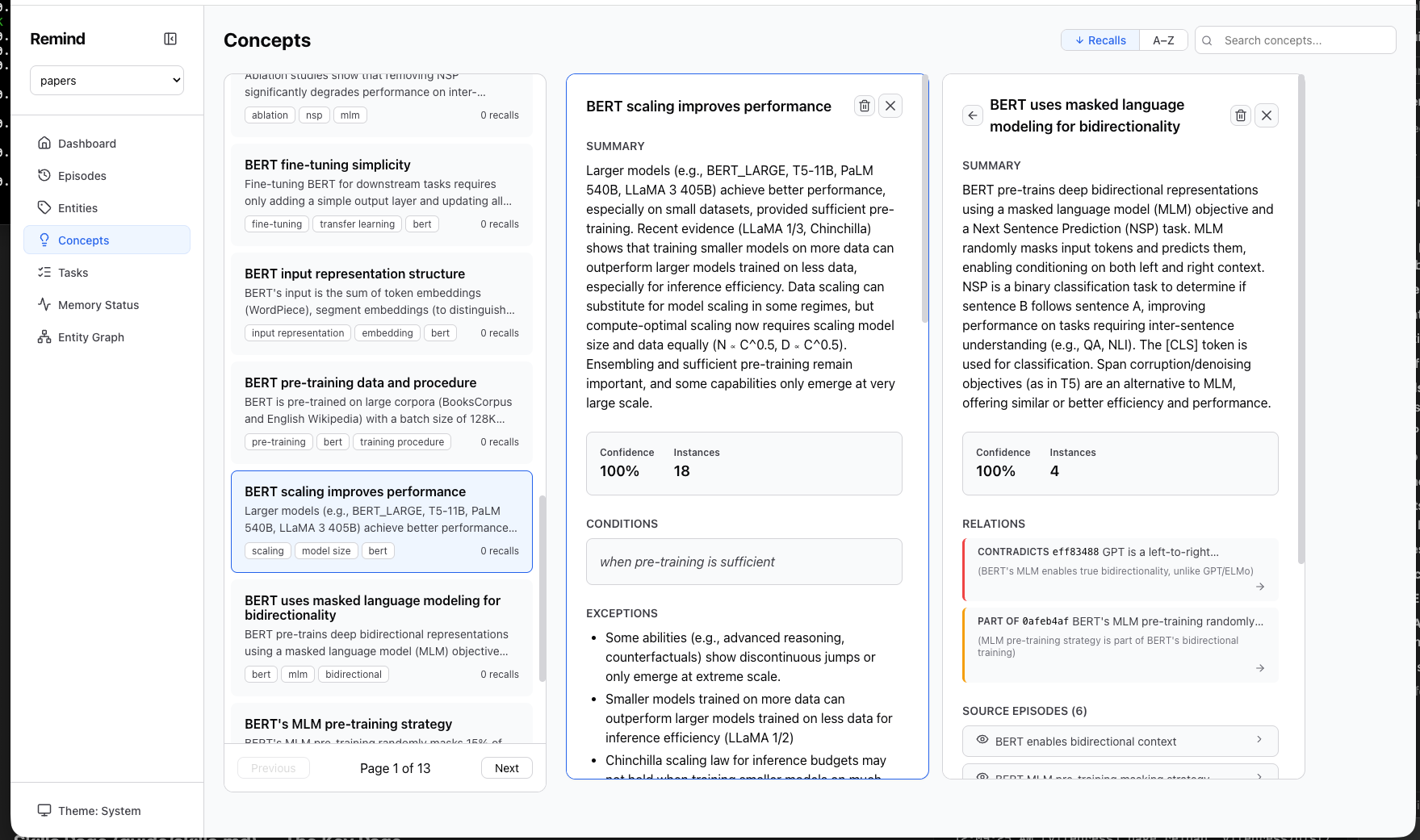
concept from=ep:1,ep:3 title="Two-tier memory architecture" "Current LLM memory systems share a two-tier architecture: fast working memory (context window) + slower persistent storage, differing mainly in how they manage the boundary"
concept from=ep:4 title="Code as memory representation" "Executable code can serve as a memory representation — more precise than natural language for procedural knowledge"
link source=$c1 type=implies target=$c2
processed ids=ep:1,ep:2,ep:3,ep:4
EOF
Querying across papers
remind recall "how do different systems handle memory retrieval?"
remind recall "memory representation tradeoffs"
remind recall "limitations" --entity subject:memory-architecture
remind recall "retrieval tradeoffs" -l survey=llm-memory
Recording contradictions
When papers disagree, the agent can create conflicts:
remind remember "Paper A claims 64-shot is optimal" -t fact -e subject:few-shot
remind remember "Paper B claims 8-shot performs equally well" -t fact -e subject:few-shot

# If collision is detected, agent can open a conflict
remind apply << 'EOF'
conflict fact_a=fact:abc fact_b=fact:def severity=medium
EOF
The result
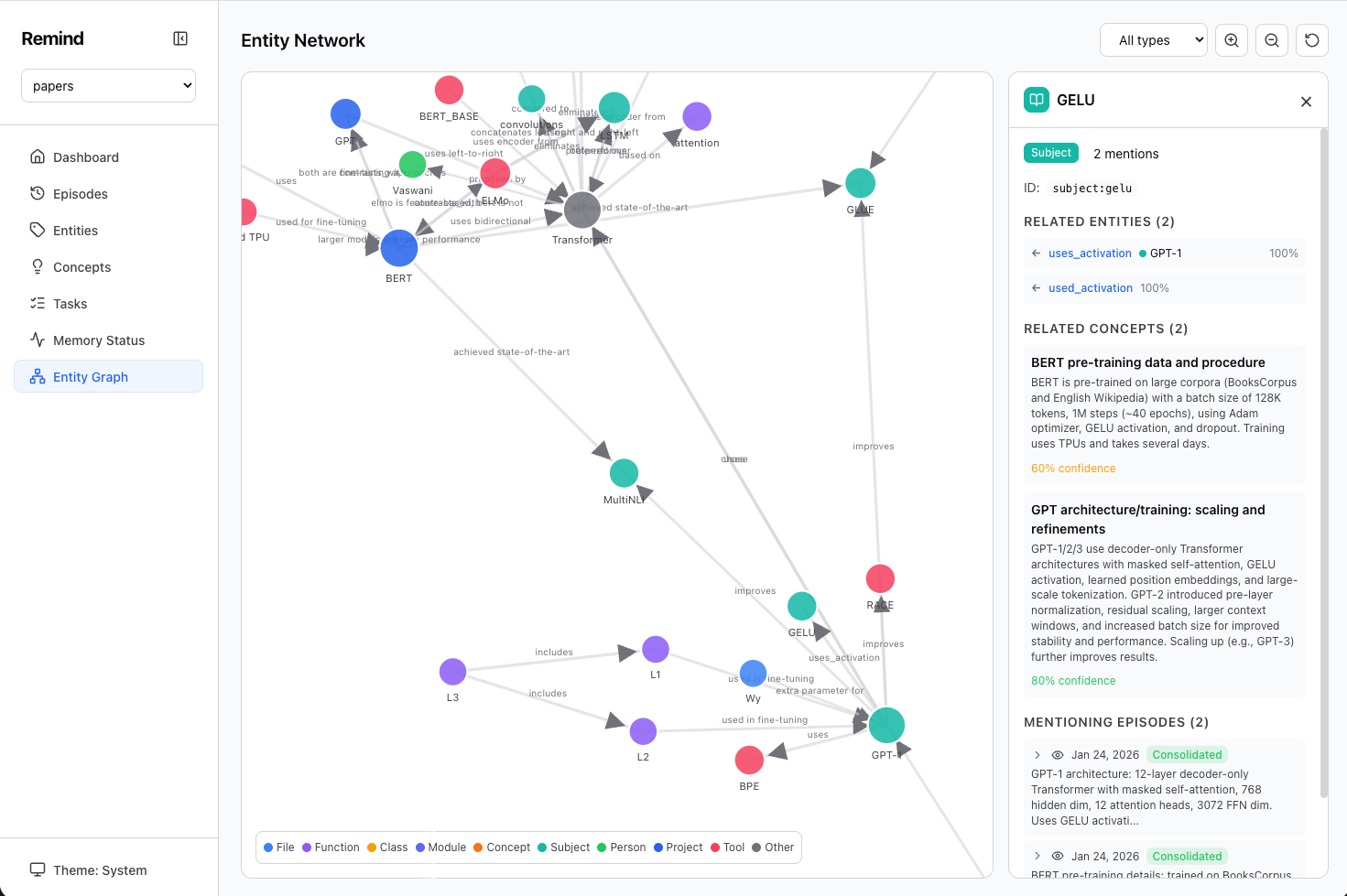
Here's what the entity graph looks like after ingesting several ML papers:
And the concepts view showing curated knowledge:
What you get
- Cross-paper synthesis — Themes and patterns that span multiple sources
- Contradiction tracking — Where papers disagree, flagged as conflicts
- Gap identification — Open questions captured as
questionepisodes - Entity graph — Navigate from an author to their contributions, from a concept to all papers that discuss it
- Persistent knowledge base — Come back months later and recall the synthesis